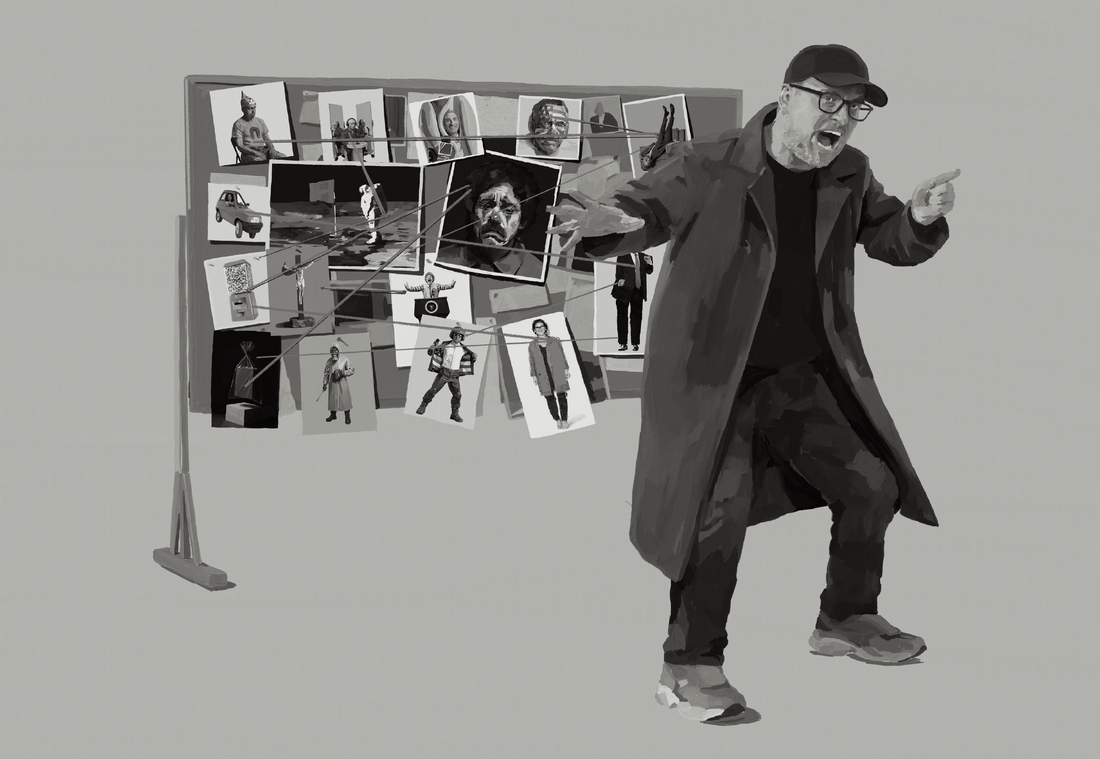
Upon the release of a new book, we like to ask our authors to share their thoughts on the how and why of their work. Bart Kiggen is the author, illustrator and designer of Red Flags, an illustrated guide to people we should've questioned sooner.
Hi Bart! Congrats on your book! This isn’t our first time working together of course: you have worked on several Luster books as a graphic designer and/or as an illustrator (like One Photo a Day and The Little Book of Solitude). This time you wanted to tell the story yourself. Why did you want to share Red Flags with the world?
Red Flags grew out of a talk I've been giving for a while called "Word Salad." People seemed to respond to my candour about the creative industry, so the initial idea was simple: could I turn that into a small book? A kind of David Attenborough-style dissection of the problematic behaviours I've encountered over 22+ years in the creative field. I started from things I noticed in my industry, stuff I was guilty of myself. Take the Branding Messiah: that was me. Maybe it still is, in some ways.
I zoomed out. My interest in politics and economics started creeping in and the project became broader.
One thing that didn't make it into the book, but it was always in the background: my oldest son was diagnosed with autism a few years ago, and once you have that lens, you start seeing a lot. The anti-vax crowd blaming mothers who took vaccines, media personalities casually dropping that they have "a touch of the 'tism", … it really gets to me. I'm a visual person, not a writer, so drawing became a way to vent. I'm also not the guy to put in front of a camera, social media style with the little mic, responding to every outrage. And I don't take myself seriously enough to become a full-fledged thought leader, LinkedIn style. So I draw.

Where did you find the inspiration and/or knowledge for this book?
Spotting red flags is easy. Most people who flip through the book recognise them instantly. But over the past year I did fall down the online rabbit hole of red flag content, and there's a lot of garbage out there. Luckily there are also some excellent books and podcasts on adjacent topics. There are too many to name here, but I put together a list at the back of the book for anyone who wants to go deeper, because this book is really more of an introduction. Some favourites: Bullshit Jobs by David Graeber, Enshittification by Cory Doctorow, and Burn Book by Kara Swisher. For podcasts: Origin Story, Pod Save the World, and The Bulwark Podcast.
Which Red Flag do you see most often in your own environment? Or which Red Flag do you consider the 'most dangerous'?
No single red flag is dangerous on its own. The problem is not noticing them, not calling them out, or worse, glorifying them. Take vice signalling, for instance: the performative embrace of bad behaviour as a personality trait or brand. People who vice signal get a spot on TV, they get a following, they run for president, they break things. That's a hyperbole, but not by much. On a smaller scale, toxic workplaces and relationships fester because nobody calls it out either. This book isn't an accusation. It's more of a "hey, let's recognise this, and maybe fix it.”
Can you tell us a bit more about how the illustrations came about? Which method/working style did you choose and why?
I chose to isolate the characters in an almost museum-like setting to magnify their behaviour. They're hand-drawn in a digital environment, though many of the props were photographed in the studio first and then illustrated. AI did play a role, but in a functional way: many of the props, like C-stands and infinity screens, were photographed first, and AI was then used to adjust camera angles or change the lighting as a reference for the illustration.
How did you repeatedly link a concrete character, a visual representation, to a set of personality traits/behaviors?

For some characters it's easy, like the Seagull Manager or the Micromanager, because the visual concept comes naturally. Others are more subtle. "Bothsides Bullshit," for instance, is rooted in the format of daytime TV talk shows, where the red flags emerge from the setup itself.
What do you want readers to take away from your book?
To look at media more critically. And to recognise it in others, or in yourself. My reflex is often to question my own behaviour. Am I being a bit too much of this red flag or that one? It keeps my ego in check. Or you just accept that you are, a little bit, a red flag yourself. That gets a chuckle too.
Does making a book as an author leave you wanting more? You are involved in many things – graphic design, illustration, video, photography, ... What is the main focus for you?
Right now I'm illustrating a new book for Luster, for another writer, so I'm keeping busy. But I don't really have a focus. People often say "oh, you do everything, that must be great!" and it is, but it's also the result of another red flag: Race to the Bottom. I do everything partly because I want to do everything, but also because focusing on just one thing isn't commercially viable. I wish it were, but it's not. So besides that, I'm working on some big branding projects, full Branding Messiah mode, and trying to sell this book. Which, in this media environment, is a challenge in itself.
Check out the book
